
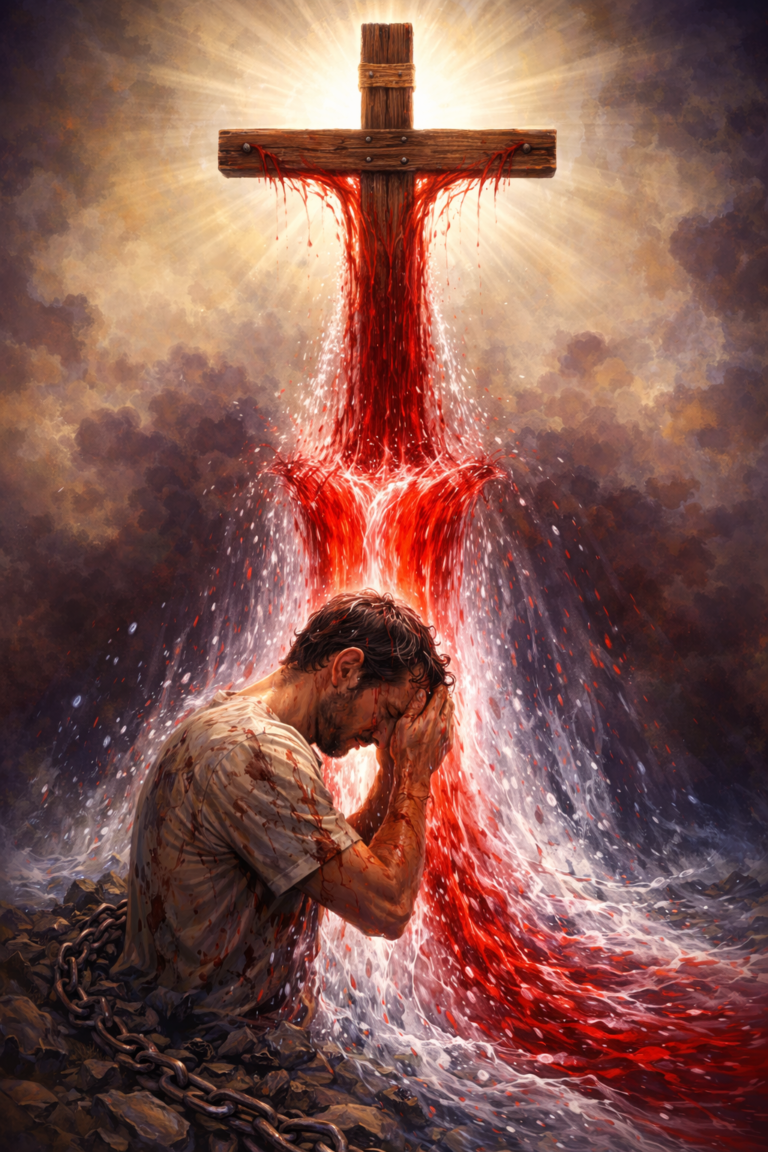
Psalm 51:5 – “Behold, I was shapen in iniquity; and in sin did my mother conceive me.”
I often find myself with eyes wide open, observing my surroundings—listening intently to what people say and how they say it. This kind of observation is key to comprehending the modern worldview: understanding how people construct their arguments, form their convictions, and reach their conclusions.
The world is changing—but not because of natural phenomena or the unfolding laws of science. Rather, the world is changing because humanity is evolving away from its Creator. While society shifts, we find our anchor in Hebrews 13:8: “Jesus Christ the same yesterday, and to day, and for ever.” He is the never-changing constant, the absolute standard, and the Uncaused Cause.
By denying this absolute standard, society inevitably degrades, transforming into something odd and undesirable. When humanity finally reaches the bottom of this descent, they will cry out for a solution. I wonder, however—will they know to whom they should bring their sorrows to, now that God has been removed with such disdain from daily life?
We find profound insight into this condition within the Book of Proverbs. Those who show disdain or hostility towards God, by turning their life away from Him. There, the wise King Solomon shares from his experience—both his life with the Lord and his time spent away from Him. Solomon was a man who understood, perhaps more than we can grasp, the weight of God’s statutes and the true nature of wisdom.
20 Wisdom crieth without; she uttereth her voice in the streets:
21 She crieth in the chief place of concourse, in the openings of the gates: in the city she uttereth her words, saying,
22 How long, ye simple ones, will ye love simplicity? and the scorners delight in their scorning, and fools hate knowledge?
23 Turn you at my reproof: behold, I will pour out my spirit unto you, I will make known my words unto you.
24 Because I have called, and ye refused; I have stretched out my hand, and no man regarded;
25 But ye have set at nought all my counsel, and would none of my reproof:
26 I also will laugh at your calamity; I will mock when your fear cometh;
27 When your fear cometh as desolation, and your destruction cometh as a whirlwind; when distress and anguish cometh upon you.
28 Then shall they call upon me, but I will not answer; they shall seek me early, but they shall not find me:
29 For that they hated knowledge, and did not choose the fear of the LORD:
30 They would none of my counsel: they despised all my reproof.
31 Therefore shall they eat of the fruit of their own way, and be filled with their own devices.
32 For the turning away of the simple shall slay them, and the prosperity of fools shall destroy them.
33 But whoso hearkeneth unto me shall dwell safely, and shall be quiet from fear of evil.
These words should be a terrifying warning to any reader—regardless of age, maturity, or whether they believe in God or not. The passage presents a very logical argument, and its conclusion is all the more sobering. Consider this: if this is the depth of wisdom found at the very beginning of the Book of Proverbs, how much more remains to be discovered in the remaining thirty chapters?
However, what I would like to bring to your attention, dear reader, is how genuinely unwise we often are in times of crisis. Instead of seeking balance, we tend to fluctuate from one extreme to another. This happens primarily because of wrong advice, leading therefore to choices which are not consistent with God’s counsel in our lives, and influences that are nothing more than a wind.
I profoundly appreciate how the Apostle Paul points out that strange doctrines are nothing but a wind. As previously mentioned, we ought to seek to stay closer and closer to the unchanging God. He is the Rock, the Pillar, and the Foundation.
When comparing the influences in our lives—books, preachers, Bible scholars, teachers, friends, and the people we interact with—I wonder if you can identify whether they are motivating you toward a closer relationship with Christ, or whether they are pulling and pushing you with “winds of doctrine.” Of course, this is something each of us must assess personally.
Turning our eyes toward God and His Word, I would like to challenge you with a subject that has convicted me deeply—one that has caused me to fall on my knees and praise the Lord. These thoughts have been on my heart for some time, triggered by an event that once again shook Christians worldwide. While the specific details of that story are not the focus here, they lead us to study another important man from human history—a man who remains a benchmark of kingship in Israel.
All kings after David fluctuated in their service to God and His chosen people. In fact, the biblical narrative evaluates roughly eight kings based on whether they followed or failed to follow “the ways of David.” As a consequence, King David remains, even today, an example by which we may evaluate ourselves—if not in kingship, then certainly in our commitment to living and upholding God’s ways.
As I mentioned earlier, I would like to dive into the Scriptures to unfold God’s great wisdom and expose ourselves to it. My hope is that we can understand when and how we are unwise—especially when life takes a sudden turn. I also want to address how easily we “cancel” people who, just like David, have fallen into sin.
I am not attempting to minimize the gravity of sin. Rather, I want to show how great God is. Men like David remained faithful to God, and their lives were restored by Him—even while they suffered the consequences of their sin and the weight of God’s righteous judgment and justice.
Yet I have noticed that people often cancel someone because of a single sinful situation, judging their entire life as being in the wrong. My encouragement today, through looking into the Bible, is to learn how to wisely discern life’s situations regarding people and sin—especially within a Christian context, a Church, or the wider Christian community.
Therefore, I propose that we analyze a specific moment in the life of David—the moment from which Psalm 51 was written with such depth of conviction, dedication, and submission to God. That moment is found in 2 Samuel, chapters 11 and 12.
The King
David was king over Israel, and the nation was at war. Scripture describes this as a time “when kings go forth to battle.” Yet David sent his servants to fight while he remained in Jerusalem. Walking upon the roof of his palace, David noticed a woman bathing; she caught his eye and stirred his flesh. The story continues with David committing a grievous sin by having an affair with Bathsheba.
When the woman became pregnant, David moved forward in an attempt to hide his affair. First, he called Uriah, Bathsheba’s husband, home from battle, persuading him to rest and enjoy time with his wife. However, Uriah was more dedicated to the affairs of war and to the LORD; he refused to go home. David then used his power to send Uriah back to the front lines, arranging for him to be placed in the forefront of the hottest battle so that he would die.
It may sound like a Hollywood story, but this is a real historical event. At the end of it, David was convicted of his grievous sin. Out of that pain, sorrow, and many tears, he penned the words of Psalm 51.
The Adulterer
There is no doubt that David committed the sin of adultery. He went out of his way to have an intimate relationship with Bathsheba. Scripture is precise in its description and exposes David’s weakness: women of a beautiful countenance.
This was not the first time David had encountered such temptation. In 1 Samuel 25:3, we read of Abigail, the wife of Nabal, described as a woman of “good understanding, and of a beautiful countenance.” Later, Abigail became David’s wife. It appears David had a weakness—one which is not unique to him, but shared by many men, regardless of their standing in Christ.
There is not much more that needs to be said concerning this matter. David committed adultery.
The Murderer
Reading the account of David’s affair with Bathsheba, we see a man desperate to cover his tracks. Whatever strings he pulled while Uriah was still alive proved unsuccessful. Instead, his efforts only highlighted Uriah’s faithfulness—to his king and to his God. He was a dedicated warrior, committed to finishing the battle he had begun.
Yet this very integrity turned against Uriah, rooted in David’s desperation to conceal his sin. Whenever these chapters are read or preached, the focus often rests almost entirely on David’s encounter with Bathsheba. But David did not fail there alone. He continued to descend further into sin, blinded by transgression and darkened in judgment by momentary pleasure.
Though David did not draw the sword against Uriah with his own hand, it was he who plotted his death. By David’s command, Uriah was left alone and abandoned on the battlefield. We do not know Uriah’s thoughts as he saw his army withdraw, leaving him to face the enemy’s valiant men alone.
When Uriah the Hittite fell in battle, the news was brought back to King David. Joab and the messenger had carefully planned how the report would be delivered, expecting the king’s anger. Instead, David responded with chilling indifference: “the sword devoureth one as well as another.” Uriah was not a mere servant; he was one of David’s faithful and mighty men—one who had served him from the beginning of his ascent to Israel’s throne.
The Abuser
The story continues with David proving able to rightly judge injustice, as we see in 2 Samuel 12. But before that, it is important to reflect on how David forced Bathsheba into his house and plotted the death of Uriah. All of this was done through the abuse of his kingship, power, and authority. Chapter 12 describes David accurately, using a method we often see Jesus’ use in the Gospels: a parable. To draw his attention and give David insight into the sin he had committed.
Meditating on the story as a whole, we ought to learn that in desperate situations, to cover up one shortfall, a chain of sinful acts will follow—even the abuse of the position and authority invested in us by God. David did not earn the crown; God chose him. God delivered him from Saul and the hands of his enemies. God protected and promoted David to the throne of Israel. David did not only abuse his earthly power, but he also acted against God by assuming authority he did not have. This is plainly depicted at the end of chapter 11, verse 27: “But the thing that David had done displeased the LORD.”
Furthermore, in chapter 12, God judges David—perhaps harshly, we might say, but God is never less than just and righteous. Reminding David first of His grace and provision, God justifies how gravely David had sinned by killing Uriah and taking his wife. However, God’s judgment ends on a graver note. Though David’s life was spared, his unborn child’s was not. Verse 14 exposes the gravity of David’s sin beyond his own house and the nations of Judah and Israel: “because by this deed thou hast given great occasion to the enemies of the LORD to blaspheme.” The repercussions of David’s sin produced a wave of malice. The enemies whom David had fought and defeated by the strength of God’s arm were now scorning God. The name of the Lord was put under the feet of ungodly men. God’s name was taken in vain, and the witness of the faithful was rendered powerless because David had lost the integrity, stature, and strength to stand uprightly.
The Weeping
“I have sinned against the LORD.”
Sin is grievous. Whenever we acknowledge its presence in our lives, our knees ought to be weakened. Our cry should be lost in the depths of the horizon. Though David committed his sins in secret, God judged him publicly, setting him forth as an example and sending a crystal-clear message to society: God is both just and merciful. Sin will always be judged and brought to justice. God will not allow His name to be mocked, dragged through the mud, or disgraced by His children. David understood and acknowledged his failure. In writing Psalm 51, he expresses in plain language his shortfall and his total dependence on God’s redemption.
David is a prime example of grave failure and sin, but he is also a prime example of turning away from sin and fully acknowledging God’s mercy and grace. Psalm 51 is a poem that has encouraged many, motivating them to repent and trust in the Lord for cleansing. What I find interesting, however, is that this poem has not been “cancelled”—nor has any other poem written In recent years, several well-known Christian figures have caused the church to pause and reflect—each for different reasons, and not all in the same category. The case of Ravi Zacharias stands as one of the most grievous, where a globally respected defender of the faith was posthumously revealed to have lived a hidden life of sexual abuse and coercion while publicly ministering in Christ’s name. His fall exposed the danger of unexamined authority and reminded the Church that intellectual brilliance cannot substitute for holiness.
More recently, the ministry of Steven Lawson—long known for his emphasis on doctrinal precision, expositional preaching, and the fear of God—was brought to an abrupt end following the public acknowledgment of serious moral failure. Though differing in nature and scope from other cases, his removal nevertheless underscored the same sobering truth: those entrusted with teaching God’s Word are held to a higher standard, and hidden sin will eventually be brought into the light.
By contrast, Philip Yancey represents a different kind of public reckoning. Rather than the exposure of secret immorality, Yancey has been known for openly recounting seasons of doubt, spiritual dryness, and disillusionment with the Church—choosing transparency over pretence. His writings remind us that honesty about weakness is not the same as hypocrisy, and that public struggle, when confessed rather than concealed, serves a different purpose in the life of God’s people.
Together, these examples—though not equal—call us back to a single truth: God is not impressed by reputation, gifting, or influence. He desires truth in the inward parts, and He alone is the righteous Judge of every man.
What are we to do in such situations? Shall we “cancel” their ministry, their work, their written books, and their sermons on the basis of their failure? Are we to cast away their service to God, even though their life and character were incompatible with God’s precepts? Why is David held in high regard, while they are dismissed?
God judges hidden sins in plain sight, especially those of men in leading and teaching positions, the same as He did with David. God’s aim is to revive His people and to send a clear message: He is just and Holy. No man may fall short of that. Though such men have taught many and exposed God’s character, their teachings may remain sound even while their character is stained. God’s name may be blasphemed because of their failing, and many believers may be shaken in their faith. However, we are not to trust in men, but in God for our salvation, sanctification, and glorification. They may have started well but finished poorly.
Nonetheless, the deeds of David and many others like him are recorded on the pages of Scripture to expose God’s character and to lead every reader to fear Him. We are not to focus on David’s failures merely to reflect on him as a negative, unapproved example; the focus of this story is God.
The Final Word
Therefore, when we hear of people falling—such as Ravi Zacharias, Steven Lawson, or Philip Yancey—we ought not to judge ourselves as being better. We are under the same types of temptations and the same judgment from God. We cannot consider ourselves to be standing on higher ground than King David. We must see God in all these examples and observe how He remains Holy and just. What saved me from the penalty of hell was God, not a man. We may hear a sermon or read a book and feel deeply convicted; perhaps it was through the teachings of these men that we were led to trust in the Lord as Savior. But salvation is by grace through faith in God, not in a human being. Christ, the Son of man, must always be glorified and respected as the One who laid down His life on the Cross.
Because, there is no book, nor sermon, nor Psalm which can remove the stain of the sin, but the blood of the Lamb.
Discover more from Calvary Baptist Church - Peterborough
Subscribe to get the latest posts sent to your email.

Leave a Reply